
KFTC's 'price police' fines risk tax losses
The Korea Fair Trade Commission (KFTC) has imposed a record of more than 4.7 trillion won in fines on eight major cases this year, but its heavy-handed approach is criticized for weak evidence and legal reasoning, raising the risk that lost lawsuits will leave taxpayers footing the bill.
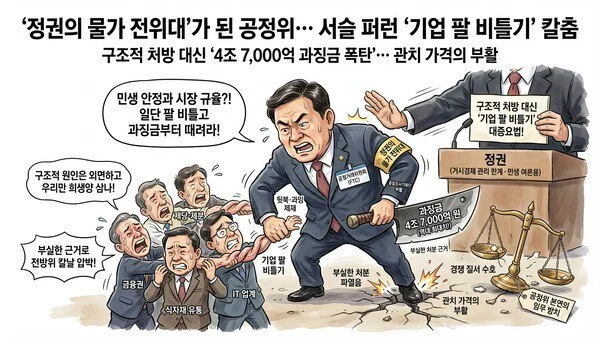
The Korea Fair Trade Commission has imposed a record of more than 4.7 trillion won in fines on eight major cases this year, and as of the end of September nine food companies had gone to court over penalties totaling 1.3109 trillion won. Its aggressive actions, from the ramen industry to Samsung Electronics, are criticized for relying on thin evidence and risking losses to the national treasury.
The Korea Fair Trade Commission (KFTC) is wielding its regulatory blade more sharply and roughly than ever. Its reach has spread beyond the financial sector and the sugar, flour and food-distribution industries to IT. This year, fines for just eight major cases have exceeded 4.7 trillion won, a new record.
When administrations hit the limits of macroeconomic management, the card they pull out to soothe public anger over living costs has always been "twisting the arms of corporations." Even the Lee Myung-bak administration, which once billed itself as "business-friendly," clung to stopgap remedies in a crisis, making conglomerates' expansion into bakeries and coffee shops a scapegoat.
The competition authority, which recently revived its "Priority Investigation Planning Group" for the first time in 21 years, is moving far more roughly than back then. It speaks of stabilizing people's livelihoods, but in reality it is acting as the administration's vanguard on prices, a chilling revival of government-dictated pricing. The sharper its blade, the louder the clash over belated, excessive sanctions and flimsy evidence.
The overreach is most glaring in the food industry. Of the roughly 4.0515 trillion won in fines imposed on six large collusion cases this year, nearly half, 1.8146 trillion won, went to three cases involving sugar, flour and starch sugar. That even exceeds the largest single fine, 1.6265 trillion won, for collusion over government bonds.
After processed food prices rose 2.9% last month, the highest in 11 months, the KFTC sent investigators to four major ramen makers, following probes of six major processed food companies.
A "fishing expedition" at the dinner table that forgets a Supreme Court defeat a decade ago
Pressing down on the lid of the ramen pot will not tame inflation, and the move risks repeating a self-defeating loss from 10 years ago. In 2012, the KFTC fined ramen makers 135.4 billion won for collusion, only to lose outright at the Supreme Court in 2016. The court ruled that latecomers following a price increase under cost pressure was "conscious parallel conduct," not an illegal secret agreement. Sending investigators based only on the timing and size of price hikes, without physical evidence, is an administratively convenient fishing expedition.
Treating food and ramen companies that buy flour as accomplices right after uncovering collusion among flour millers is also a logical leap. If the raw-material collusion is real, these companies are closer to victims who had to absorb higher costs. Intimidating companies over prices instead of using quota tariffs on grain or releasing stockpiles will only reduce consumer welfare, for example through "shrinkflation."
Inflated calculations that ignore how markets work, and a stubborn sanction four years late
Sanctions detached from reality are repeated in distribution, finance and IT. In the CJ Freshway case, the examiner treated donations to welfare facilities and gift certificates as undue inducements and set the related sales at 499 billion won. Strong rebuttals argue that the donations are evaluation criteria disclosed transparently under accounting standards, that prices cannot be raised afterward under the fixed unit prices of bids, and that sales unrelated to the profitability simulation tool were also counted.
Sanctions in the 1.9 trillion won range over government bonds and commercial banks' loan-to-value (LTV) ratios are likewise criticized as inflated figures that ignore market-making obligations and revenue structures.
The height of this stubbornness is the roughly 20 billion won fine on Samsung Electronics over its "Game Optimizing Service (GOS)." In February, the Seoul High Court had already ruled that the service was a "necessary measure" to curb overheating, among other purposes, and not deceptive advertising. All 1,690 consumers involved accepted the measure and even withdrew their complaints to the KFTC, and lawsuits overseas have ended. The issue was resolved by an update in March 2022, just two weeks after the product's release, yet four years later the KFTC brought down a belated hammer, relying on YouTubers' videos (1.47% of actual users) rather than empirical data.
A boomerang of lawsuits and the contradiction of "bombs first, analysis later"
A sword dance without empirical evidence or legal reasoning points to an unprecedented wave of lawsuits and losses to the treasury. As of the end of September, nine food companies alone had sued (over 1.3109 trillion won in fines), and the financial sector and Samsung Electronics are poised to join them. Cases such as GOS, where the Seoul High Court, which has exclusive jurisdiction over KFTC appeals, has already rejected the claim of deception, carry a high risk of defeat.
Dropping fine bombs worth trillions of won and only then planning to more than triple next year's economic analysis budget amounts to admitting the sanctions were haphazard. No one takes responsibility for the stigma companies suffer if the KFTC loses, and the litigation costs and the 3.1% annual interest added to refunds must be covered with taxpayers' money. The KFTC is not a ministry for fighting inflation. It should take off its "price police" armband and return to market autonomy and the rule of law.
*Notice from Naewoe Economy TV: This article was written by the author and then corrected, proofread and refined using AI. AI-generated images in the article are noted in their photo captions.

Comments 0