
Clinics paid Chinese hackers for fake reviews
The Seoul Metropolitan Police Agency's Cyber Investigation Division said on Nov. 26 that 52 people, including Gangnam plastic surgery clinic directors, had been sent to prosecutors for posting about 8,400 fake reviews using some 800 accounts bought from a hacking group in Qingdao, China.
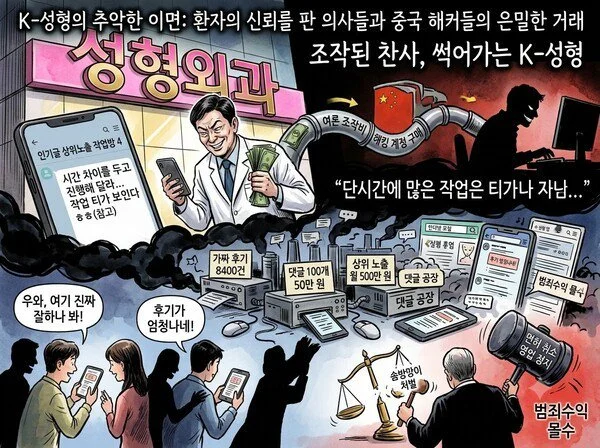
The Seoul Metropolitan Police Agency's Cyber Investigation Division announced on Nov. 26 that 52 people, including plastic surgery clinic directors in Seoul's Gangnam district, had been sent to prosecutors for spreading about 8,400 fake reviews over five years. The investigation found that the clinics had used some 800 accounts bought from a hacking group in Qingdao, China, to manipulate online comments and rankings.
"Doing a lot of work in a short time is too obvious, so please space it out." This was not a covert order from a criminal syndicate but an instruction sent to an agency by the marketing team of a well-known Gangnam plastic surgery clinic. Medical institutions that put scalpels to patients' faces were fussing over the "finish" of their comment manipulation like back-alley brokers. The investigation results the police released on Nov. 26 lay bare just how rotten the underside of glamorous K-plastic surgery has become.
Doctors who sold patients' trust and fattened Chinese hackers
What the 52 people, including clinic directors, are accused of goes beyond ordinary illegal medical advertising. From August 2021, over five years, they posted about 8,400 fake reviews and comments using roughly 800 other people's accounts, bought for 30,000 won apiece from a hacking group in Qingdao, China. There was even a price list: 40,000 won per review, 500,000 won per 100 comments and 5 million won a month for top placement.
Some hospitals went as far as setting up their own in-house agencies, using patients' before-and-after surgery photos without consent. They also systematically posted so-called "care comments" under negative posts, such as "Go for a consultation and compare for yourself."
Even more alarming is that these deals fed directly into the funding of international cybercrime. The police warned, "Fake reviews create demand for stealing and selling accounts, which grows the crimes of hacking groups." It is a grotesque ecosystem in which advertising money paid by hospitals flows into Chinese hackers' pockets and is then used to hijack more Korean citizens' accounts.
Doctors, whose livelihood rests on trust, were blinded by money, sold out patients' information and volunteered to serve as hosts for international crime. It is fair to call it the ethical bankruptcy of the medical profession.
A "practice" flagged 10 years ago, repeated: complicit platforms and enforcement gaps
Turn the clock back exactly 10 years to June 2016, and the picture is staggering. Back then, five people, including a Gangnam plastic surgery clinic director, were indicted for buying the personal information of thousands of people, setting up an in-house agency and posting fake reviews. The following year, 21 plastic surgery clinics and nine agencies were investigated en masse on suspicion of posting fake reviews on a popular cosmetic surgery app.
Even then, fake reviews were singled out as a chronic industry practice, and there were widespread calls for continuous police investigations.
Yet the reason the same crime keeps recurring a decade later is clear. The authorities' surveillance net, despite all the talk of constant crackdowns, never actually worked on the ground. This comment factory, too, was uncovered by chance during an investigation into an ordinary hacking case, not through routine enforcement.
While 8,400 fake posts poured out over five years, the apps and portals that touted "24-hour clean reviews" effectively looked the other way, in a structure where fake reviews translated into traffic and ad revenue. It is the result of investigative gaps combined with the hypocritical complicity of platforms.
End slap-on-the-wrist penalties; hold licenses and platforms accountable
Above all, the decisive cause is a penalty structure in which the huge profits from manipulation far outweigh the legal costs of getting caught. The Medical Service Act's lenient penalty provisions are treated by Gangnam plastic surgery clinics as little more than "operating expenses." Even after a court handed prison sentences to a ring involved in ranking manipulation last year, the illegal market did not budge.
One-off crackdowns and token fines must end. Medical institutions involved in manipulating public opinion should face punitive sanctions, from full confiscation of criminal proceeds to business suspension and license revocation. Portals and medical information platforms that neglect fake reviews should face heavy penalty surcharges, and a duty of constant verification should be written into law.
If this ugly practice of luring patients with manufactured praise is not broken, the fall of K-plastic surgery is only a matter of time.
*A note from Naewoe Economy TV: This article was written by the author and then corrected, proofread and polished using AI. AI-generated images included in the article are identified in their photo captions.


Comments 0