
Gyeongsangbuk-do to invest 236 billion won in advanced industry talent
Gyeongsangbuk-do Provincial Government has announced a strategy to build a regional talent ecosystem by training specialists in five key strategic industries, including AI semiconductors and secondary batteries.
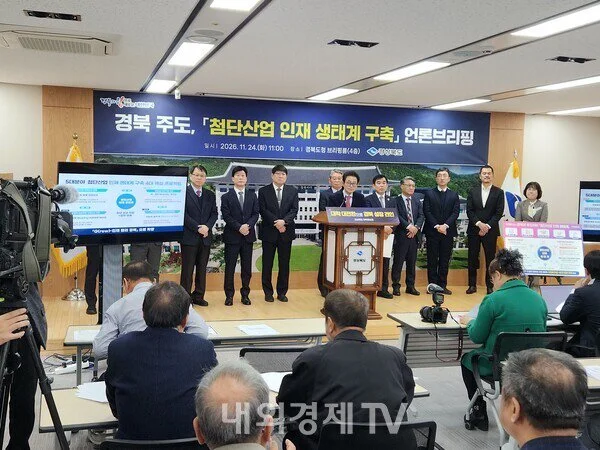
Gyeongsangbuk-do Provincial Government announced on the 24th a plan to invest 236 billion won over four years to cultivate 42,000 specialists in five strategic industries, including AI semiconductors and secondary batteries.
Gyeongsangbuk-do Provincial Government is moving to secure future industrial competitiveness and drive regional economic growth through the cultivation of advanced industry talent.
The strategy focuses on intensively nurturing professional personnel in five major advanced and strategic industries: AI semiconductors, advanced AI robots, future mobility, secondary batteries, and bio-industry. The plan aims to establish a region-led talent ecosystem that connects universities, companies, and research institutes.
On the 24th, Gyeongsangbuk-do Provincial Government announced the 'Advanced Industry Talent Ecosystem Construction Strategy' at a briefing room in the provincial office, with Governor Lee Cheol-woo in attendance.
A total of 236 billion won will be directly invested in this project over the next four years. Separately, the province plans to provide indirect financial support of more than 300 billion won annually by utilizing a university support anchor system. In 2027, 59 billion won of the total project budget will be invested.
Through this project, Gyeongsangbuk-do Provincial Government has set a goal to cultivate approximately 42,000 talents in advanced industry fields and 230,000 talents required by companies.
The plan specifically aims to connect the education and research capabilities of local universities with industrial sites to supply the professional workforce needed by companies, thereby leading to corporate investment attraction and the creation of youth jobs.
During the briefing, Governor Lee Cheol-woo emphasized, "The competitiveness of advanced industries cannot be secured with technology and capital alone," adding, "Ultimately, it is people who develop technology, lead industrial innovation, and create new markets."
He further stated the necessity of building a sustainable advanced industry talent ecosystem that nurtures talent and grows industries within the region, noting, "South Korea's future competitiveness begins with talent."
Transforming 31 local universities into core hubs for industrial innovation
Gyeongsangbuk-do Provincial Government will foster 31 local universities as core hubs for advanced industry talent cultivation and technological innovation.
The province plans to specialize these universities by linking their individual strengths and characteristics with the region's major industries, while expanding advanced experimental and practical facilities and increasing joint education and research between universities.
The function of universities will also expand beyond traditional education-centered roles to become innovation hubs that lead R&D and technology commercialization while solving technical challenges at industrial sites.
To achieve this, a cooperation system involving universities, companies, research institutes, public institutions, and private experts will be established, creating an environment where industry experts and excellent researchers conduct education and research together.
The full-scale implementation of demand-customized talent cultivation, where companies participate from the curriculum design stage, will also begin.
The plan includes expanding specialized contract departments and customized curricula, and strengthening field training, internships, industry-academic joint projects, and employment-linked programs to ensure that the expertise learned at universities translates into actual industrial competitiveness.
Driving 4 core projects... focusing on semiconductor, robot, and secondary battery specialists
The Gyeongsangbuk-do Provincial Government's advanced industry talent ecosystem project will be carried out through four projects: Advanced Industry Colleges, Strategic Industry Anchor Universities, Supra-regional Shared University Governance, and Growth Engine Talent Cultivation.
First, 80 billion won will be invested in the Advanced Industry Colleges project.
This project aims to cultivate 15,000 specialists, centered on the semiconductor, robot, and secondary battery fields. The province will strengthen field-oriented education and research capabilities by having universities and companies jointly operate specialized contract departments and customized curricula, and by establishing specialized convergence research institutes and joint corporate research centers.
Gyeongsangbuk-do Provincial Government plans to conduct an open call for participating universities within the province in early 2027.
The Strategic Industry Anchor Universities project will receive 60 billion won.
This project aims to cultivate 20,000 specialists in the AI, advanced mobility, and bio fields, with five universities participating: Yeungnam University, Kyungwoon University, Daegu Catholic University, Daegu University, and Kyungil University.
The province will work to secure specialized personnel for each industry through the operation of the Gyeongbuk AI Convergence Institute, joint corporate projects in the aviation and defense sectors, and the operation of bio-convergence majors.
36 billion won will be invested in establishing Supra-regional Shared University Governance.
Centered on Kyungpook National University, a major national university in the Daegu-Gyeongbuk region, the project plans to share educational and research resources among regional universities and cultivate 3,900 specialists in five major industries: semiconductors, robots, secondary batteries, future mobility, and bio-industry.
To this end, a supra-regional cooperation system involving eight universities in the Gyeongbuk region, universities in Daegu, companies, and research institutes will be established to promote joint education, industry-academic joint research, credit exchange, and sharing of research equipment.
The Growth Engine Talent Cultivation project will receive 60 billion won.
This project aims to cultivate 3,000 specialists, focusing on physical AI-based semiconductor materials, parts, and equipment, as well as AI manufacturing robots.
Managed by Gyeongsangbuk-do Provincial Government and Kumoh National Institute of Technology, the project will involve participation from Daegu Metropolitan City, universities in the Daegu-Gyeongbuk region, companies, high schools, and research institutes to promote joint education between universities, mutual recognition of credits, employment/startup links, joint research, and technology transfer.
Building a growth structure where talent attracts companies and companies settle youth
A key focus of Gyeongsangbuk-do Provincial Government's strategy is linking talent cultivation to industrial growth and regional settlement.
The province intends to link education and employment policies so that the professional workforce required by companies is trained at local universities, and graduates can find employment or start businesses at local companies.
Through this, the province aims to establish a foundation for settlement where young people can learn, work, and grow in Gyeongbuk without moving to the Seoul metropolitan area. Additionally, the 'TF' will be operated to strengthen linkage and cooperation between projects, ensuring efficient use of human and material resources held by universities, companies, and research institutes.
Gyeongsangbuk-do Provincial Government expects that once the supply base for professional personnel is established, it will have a positive impact on regional corporate investment and the revitalization of industrial complexes.
However, for large-scale financial investment to lead to actual industrial competitiveness, the continuous participation of companies, the field suitability of curricula, and securing the employment and settlement rates of the trained talent within the region are critical.
Ultimately, the success of this project depends on more than just how many talents are cultivated; it depends on how much they contribute to the growth and technological innovation of local companies and how many settle in Gyeongbuk.
Attention is focused on whether the advanced industry talent ecosystem being promoted by Gyeongsangbuk-do Provincial Government can establish itself as a region-led industrial growth model that connects universities, companies, and youth.


Comments 0