
LPTech CEO Park Hyeong-sun eyes robot hands
LPTech CEO Park Hyeong-sun talks about developing intelligent grippers that remove the need for complex robot teaching, aiming to solve automation challenges in high-mix, low-volume manufacturing, and about plans to expand into hands for humanoid robots.
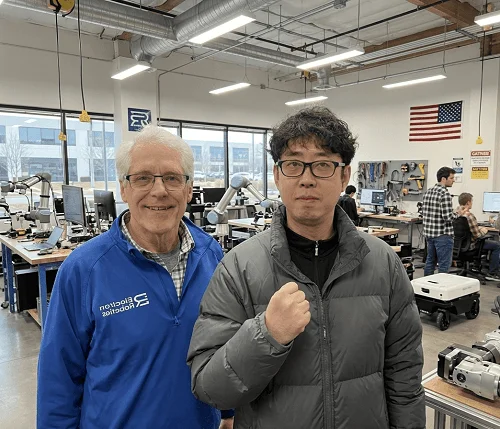
LPTech is developing intelligent grippers and multi-fingered hands for humanoids to tackle the challenges of high-mix, low-volume production. Since introducing its teaching-less gripper, now branded 'Logipick,' in 2022, the company has focused on reducing sensor dependency and the need for engineers to reconfigure robots.
Robot automation that can handle high-mix, low-volume production is becoming more important in manufacturing. Conventional automation, which requires specialist engineers to reconfigure robots whenever the size or shape of the target object changes, weighs on production changeover time and operating costs.
To address these problems, robot automation company LPTech is developing intelligent grippers and industrial automation systems that can grasp objects of various sizes without separate, elaborate teaching (setting robot motions).
Its flagship product, 'Logipick,' is built on in-house control software and focuses on reducing sensor dependency and the setup needed when the target object changes. Building on technology accumulated while developing industrial grippers, LPTech is also preparing to develop multi-fingered intelligent grippers for humanoids.
We met LPTech CEO Park Hyeong-sun to hear about his experience in robot automation, why he founded the company, the competitiveness of its core technology, and its strategy for entering the humanoid market and growing the business.
Q. What led you to found LPTech, and what problems did you want to solve in robot automation?
A. I have worked in robot automation for about 18 years. I majored in electronics and studied robot-related systems at Hanyang University's graduate school. Before starting the company, I worked as head of a corporate research lab and developed various automation technologies.
Around 2018-2019, I led a government-funded project to build a smart factory for garment manufacturing in Iksan, North Jeolla Province. While building an automation system that produces clothing with robots, I ran into a number of technical difficulties.
The hardest part to solve was the robot's fingers. Because clothing is made of breathable fabric, there were limits to picking it up stably using only air suction. But using ordinary robot grippers required precise pressure or contact sensors, which raised costs.
That led me to try developing a technology that could grasp objects stably without sensors. Experts around me said it would be hard to achieve, but I kept at the research and eventually succeeded.
Another major problem in bringing automation to industrial sites is the time and cost of teaching. With conventional robots, specialist engineers often have to change the settings whenever the size or shape of the target object changes.
In manufacturing environments where high-mix, low-volume production is growing, this work can drag down productivity. LPTech started out to solve these problems and provide robot automation solutions that on-site workers can use easily without specialized technical knowledge.
Q. Please introduce LPTech's core business and main products.
A. LPTech develops intelligent robot grippers, industrial automation systems and robot control solutions. We handle the technology needed for robot automation, from product planning and R&D to design, manufacturing and mass production.
Our core product is the teaching-less gripper. We introduced it in 2022 and recently registered the trademark 'Logipick' to organize the brand.
The teaching-less gripper was developed to grasp objects without separate, elaborate settings even when the size of the target object changes. This differs from conventional industrial grippers, which require size or position information to be entered in advance.
We are also developing anti-vibration and seismic-resistant grippers designed to withstand vibration and external shocks. They are meant to ensure stable performance when transporting precision materials or heavy loads.
Customized robot automation cells that work with existing equipment at manufacturing sites are another major business. We focus on letting customers apply automation to the processes that need it without replacing all of their production equipment.
LPTech's products are currently supplied to industries such as semiconductors and displays. They are mainly applied at end manufacturing sites through system integration (SI) companies.
I see us not simply as a robot parts maker, but as an R&D-driven company that solves real industrial problems with software and control technology.
Q. How is your flagship product, Logipick, different from existing industrial grippers?
A. The biggest difference is that it can grasp objects with less separate teaching work.
With conventional robot grippers, when an object's size or shape changes, you have to reset how far the fingers should move. To do that, companies often check object information with cameras or sensors, or workers specify the movements directly with a teaching pendant.
Logipick reduces the dependence on such pre-settings. The key is controlling the gripper so it can grasp an object without the object's size being entered each time.
At the heart of this is our in-house software. The gripper's mechanical design matters, but I believe what really sets it apart is the internal control algorithm.
Many conventional grippers operate by receiving signals from sensors. We designed ours to perform the necessary calculations in our own program without relying on separate sensor signals.
This structure helps cut component costs, and because there is less sensor signal processing, it also has an advantage in operating speed.
In addition, conventional motor-driven grippers sometimes require separate drivers, controllers and multiple cables. We simplified this setup so the gripper can be used with just two connection wires.
Of course, this does not mean cameras or sensors are unnecessary in every automation process. Some tasks may require vision systems. But our technology is based on the idea that complex equipment does not have to be added for the basic task of checking an object's size and grasping it.
Q. How much have work efficiency and productivity improved at actual manufacturing sites?
A. The productivity of automation equipment depends not only on how fast the robot moves, but also on the preparation time needed when the work target changes.
On conventional automation lines, specialist engineers sometimes have to reset the robot's position and movements when switching to a new item. Depending on the process, this can take anywhere from several hours to several days.
LPTech's teaching-less system focuses on reducing the resetting needed when the work target changes.
In one case involving a multi-product parts machining process, setup work that took about two to three hours every time the item changed was cut to within 10 to 15 minutes. Based on the application cases we have compiled, we have reduced changeover time by as much as 80-90% or more.
At some sites, production efficiency rose by more than 30% on average. However, these figures can vary depending on how the process is configured and the existing equipment.
What matters is reducing the burden of having specialist engineers constantly step in to run the automation system.
At manufacturing sites where the work target changes frequently, changing the settings every time is itself a cost. Reducing that burden can raise equipment utilization and make operation easier for workers.
Small and midsize manufacturers often find initial investment costs and hiring specialists burdensome. So rather than replacing all equipment at once, I think it is more realistic to add the necessary automation devices to existing equipment.
LPTech provides modular solutions that can be applied at such sites.
Q. How do you approach R&D to stay technologically competitive, and where is your technology heading?
A. R&D is at the center of LPTech's business. We design and build grippers, but I believe our core competitiveness lies in the control software.
We developed the main control technology we use ourselves. We filed patents for the mechanical parts, but deliberately did not patent the core software in order to protect the technology.
Because filing a patent requires disclosing the technology, we are careful about how we manage our core algorithms.
In product development, we first decide the basic structure and design direction, then work with outside specialist firms on detailed design and parts manufacturing.
Separating R&D from production in this way allowed us to focus on developing core technology.
We are now refining our gripping-force control algorithm and researching structures that can operate stably in industrial environments with vibration or external shocks.
Going forward, we plan to develop technology that links vision systems with grippers and technology that precisely adjusts gripping force to an object's material and strength.
In particular, we see integration with deep learning-based 3D vision and intelligent control that reflects changes in force as useful in fields that handle precision parts or easily deformed materials.
But what matters is not the term artificial intelligence itself, but what problems it can actually solve on site. Our products can perform the necessary functions with their own calculation programs alone, and I think AI should be combined appropriately where it is needed.
Q. What are your business results in Korea and overseas, and how do you plan to expand production capacity?
A. LPTech's products are currently supplied mainly to automation projects linked to large corporations. However, rather than delivering directly to end customers, we often supply through SI companies or distribution partners.
Our products are also used overseas, including in Vietnam and the Philippines, and overseas end customers are mainly managed by partner companies.
The biggest limitation I have felt in running the business has been production capacity.
Even when order inquiries came in, there were times we could not meet them all because our production capacity was insufficient. Last year we received orders in the 4 billion won range, but could not deliver all of them.
This year, too, we expect sales in the 4 billion won range given our production limits. The challenge now is not a lack of demand, but limits on how much we can supply.
Early on, we preferred working with outside specialist firms rather than running a large factory ourselves. That let us cut fixed costs and focus on R&D and sales.
But as the business grew, the need to expand production capacity increased.
The investment we are now pursuing and our preparations for an initial public offering (IPO) are part of building that growth foundation. Once financing is secured, we plan to expand our production facilities and organization to capture demand we previously could not meet.
Overseas, we intend to expand our supply chain while keeping a partnership structure with local agents and SI companies.
Q. Why are you focusing on the humanoid robot market as a next-generation growth area?
A. The area LPTech intends to focus on going forward is grippers for humanoids.
Humanoid robots move in a human-like form, but technical challenges remain before they can perform a wide range of tasks at actual industrial sites.
Among them, I believe the hand is especially important.
Technology for robots to walk and move has advanced considerably, but there is still much room for progress in technology that precisely grasps and manipulates various objects like a human hand.
For example, for a robot developed for making coffee to perform new tasks in a different environment, it needs control technology suited to the target object and the situation.
This kind of adaptability is essential if humanoids are to expand into a variety of industries rather than staying limited to specific tasks.
While developing industrial grippers, we have built up control technology that responds to the size and shape of objects. Extending it to grippers for humanoids is the next step.
We are now preparing to develop and commercialize intelligent multi-fingered grippers with a structure similar to the human hand.
Humanoid robots may be used in many industries in the future, but I do not think the market has fully formed yet.
So for now, we need to focus on securing technology and improving practical applicability.
Rather than LPTech developing an entire humanoid itself, we expect that securing competitiveness in hands and grippers will allow us to work with a variety of robot makers in the future.
Q. What are your future growth strategy and organizational plans, including preparations for a KOSDAQ listing?
A. We are preparing for a listing on KOSDAQ through its technology-based special listing track. We have signed related contracts with a securities firm and are considering November 2027 as the target.
However, an IPO is not finalized just because a contract has been signed. Because it involves several procedures, including technology evaluation, screening, and corporate financial and management controls, whether we actually list may depend on our preparations and the screening results.
Until now, LPTech has run its business with a small staff and outside partners. Until last year, we kept the organization lean enough that a few people, including myself, handled the main work.
But as we prepare for investment and a listing, the way we run the organization is changing.
We recently expanded our staff to about seven people and are hiring more. Executives responsible for management and administration have also joined to strengthen our expertise in those areas.
Going forward, I plan to focus on areas where we can compete directly, such as R&D and sales, and leave organizational management and administration to experts in those fields.
Even as a company grows, it is not efficient for the CEO to decide and manage everything alone. It is important to create a structure that respects each field's expertise and lets people work responsibly.
Also, as the company grows in size, I think we can consider partnerships with or acquisitions of companies that have technology and business capabilities, rather than simply adding staff.
Above all, what matters is not the IPO itself, but using it to strengthen our production capacity and technological competitiveness and build a corporate structure that can keep growing.
Q. What is your management philosophy, and what kind of company do you want LPTech to become?
A. Basically, I want to build a company where members can take responsibility for their own work and enjoy what they do, rather than being held back by unnecessary constraints.
Through my career and business experience, I have come to believe that results do not come only when all employees gather in one place and commute at set hours.
In fact, LPTech runs offices in several regions, taking into account where employees live and the nature of their work.
Even though our headquarters is in Daejeon, I do not think employees living elsewhere need to travel long distances every day. Cutting commuting time and focusing on their own work can be more efficient.
I also value a structure in which people are rewarded based on their performance. What matters is not simply filling working hours, but how responsibly people carry out their assigned work.
We apply the same principle to technology development. No matter how sophisticated and advanced a technology is, it is meaningless if it is hard to use at actual industrial sites.
LPTech's direction is to develop technology that is easy to apply on site, reduces the operating burden and raises customers' productivity.
In the long term, I want LPTech to grow beyond industrial grippers into a company that is competitive in intelligent grippers for humanoids.
When people hear the name LPTech, I hope they will see it not as a simple robot parts maker, but as a company developing technology for the hands of humanoid robots.
We will keep developing technology that is actually needed on site and expand our business in robot automation markets at home and abroad.

Comments 0