
Nonghyup branch faulted over fraud response
An elderly business owner in South Chungcheong Province who sought help at a local Nonghyup cooperative branch over a suspected "account freezing" scam was told to call another bank directly and faced suspect-like questioning from a senior employee. The customer's guardian says the family will file complaints with financial authorities if further harm results.

A supervisor-level employee at a local Nonghyup cooperative branch in South Chungcheong Province is facing criticism for failing to protect an elderly customer who reported two suspicious deposits totaling about 900,000 won. Instead of handling the case through inter-bank procedures meant to guard against "account freezing" fraud, the employee allegedly questioned the depositor like a suspect and later handed the matter to a junior employee.
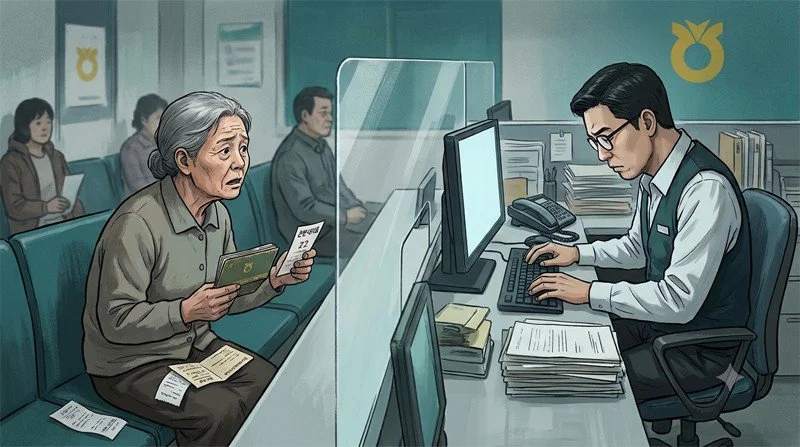
A, an elderly self-employed business owner, visited a local Nonghyup cooperative branch in South Chungcheong Province on suspicion of an "account freezing" scam that exploited the account number A had posted at the shop's entrance. Criticism has arisen after C, a supervisor-level employee at the counter, put off handling the matter on the spot, saying C was busy, and told the elderly customer to call another bank's customer center directly from the waiting area.
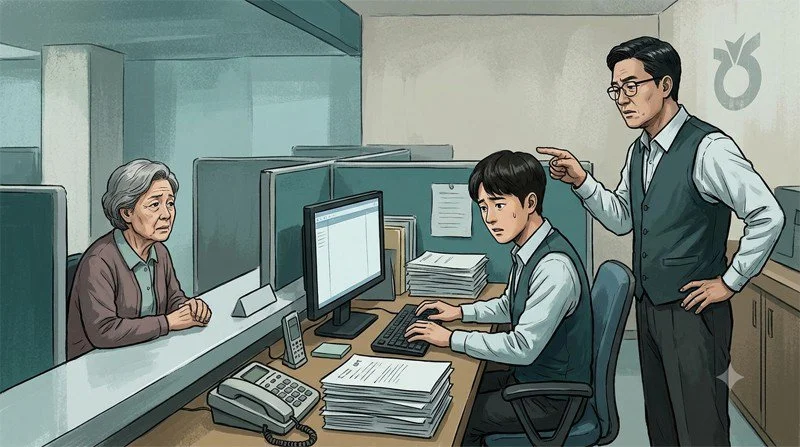
C skipped essential electronic records and guidance on victim protection while asking the elderly depositor a string of probing questions like an investigator. The next day, after the customer's guardian had warned of a possible formal complaint and returned to the branch, C handed the work to a junior employee in the name of "training" instead of apologizing and resolving the matter in person, drawing accusations of evading responsibility.
The incident began when a sender registered under a foreign national's name, a complete stranger, deposited a little over 900,000 won into A's checking account at the cooperative in two transfers about two weeks apart, early and late this month.
Because A had posted the account number outside the shop for customers' convenience, the account was exposed to the public. Fearing the so-called "account freezing" crime, in which scammers deposit voice phishing proceeds into an account to get the entire account frozen, A recently went in person to the branch where A banks.
On that first visit, however, the counter's response ran directly against the basic duties of a receiving financial institution.
Under the current financial system, returning mistaken transfers and handling funds suspected of fraud are matters to be resolved by exchanging "return request messages" over financial institutions' internal electronic networks. The receiving branch's proper role is to protect its own depositor at the counter and secure objective evidence until the electronic request from the other bank arrives.
Even so, C sent the elderly customer back to the waiting area, citing C's other work, and had A call the sending bank's customer center directly, pushing onto the depositor a responsibility that should be handled through the inter-bank system.
The employee's avoidance of handling the matter in person immediately created a risk of personal information leaking. As A sat alone in the waiting area on the phone with the other bank's customer center, A's account number, mobile phone number and deposit dates were at risk of being passed to the sender's side, prompting strong concern from A's guardian, B, who joined belatedly by phone.
In account freezing schemes, once fraudsters obtain a victim's phone number, it quickly leads to extortion and threatening calls demanding settlement money. Yet C only defended the other bank's actions and did not give even basic preventive advice, such as watching out for threatening calls from unknown numbers and never sending money.
Call recordings also captured C explaining the rules backward and delaying the request.
C told B, "It's more important to find out who sent it first," and "We have to ask the other bank," explanations that are the opposite of the actual mediation procedure for returning mistaken transfers. C also mistook a message B had prepared and sent to A, listing documents to submit to the police, for an ordinary deposit text, which dragged out the conversation. Only after a long delay did C ask for a waiting number and ID and start printing the transaction history.
Questions that seemed to treat the depositor as a possible accomplice, while essential protective steps were skipped, fueled criticism of secondary victimization.
During the call, C repeatedly asked A questions unrelated to banking business, such as "You say you never gave out the account number, so how did this person know to deposit money?", "Isn't there a foreigner you'd be receiving money from?" and "Didn't you come in together and do this?", leaving the elderly depositor to prove A's innocence.
Even after confirming the two deposits while checking the account history, C gave no guidance at all on separating funds in case the whole account was frozen, or on registering the intent to return the money in the internal system (customer consultation history).
Feeling uneasy, A withdrew the account balance for a time. With B's help, A returned to the branch the next morning, redeposited the suspicious amount plus enough to cover automatic transfers, and completed a temporary suspension of the account (an incident report) and the electronic record.
The problem is that senior employee C's irresponsible attitude continued during the return visit the next day. Although B had formally warned that they might report the matter to financial authorities over C's wrong guidance and improper handling the day before, C passed the counter work to a junior employee in the name of "staff training" instead of stepping forward to apologize and finish the job.
In the end, the deposit and temporary suspension were completed through the junior employee, but the supervisor-level employee who caused the problem is hard pressed to escape criticism for dodging the responsibility to apologize personally and clean up afterward.
B, the guardian, said, "If we are suspected of running a voice phishing account and end up investigated or sued, or suffer harm such as an account freeze, we will formally report this to the Financial Services Commission, the Financial Supervisory Service and the National Agricultural Cooperative Federation based on the call recordings and visit records we have, and hold them strictly accountable."



Comments 0