
Community Chest of Korea forum addresses hurdles to digital asset donations
A recent study revealed that only 3.5% of adults have experience donating digital assets, despite the practice being legally permitted. At a National Assembly forum, experts discussed the need for clearer tax standards and simplified verification processes to encourage digital asset philanthropy.
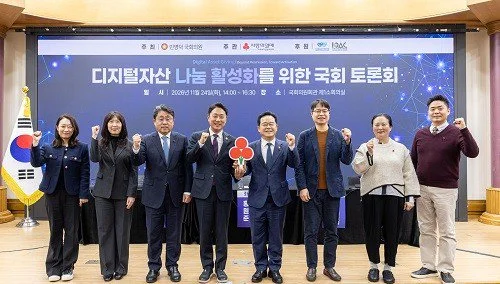
The Community Chest of Korea held a forum at the National Assembly on the 24th to discuss expanding digital asset philanthropy. Despite 32.9% of surveyed adults holding virtual assets, only 3.5% have experience donating them due to unclear tax standards and regulatory barriers.
While donating digital assets has been institutionally permitted, the actual experience rate for such donations stands at only 3.5%. Low awareness of digital asset donations, unclear tax standards, and stringent eligibility requirements for non-profit organizations have been identified as obstacles preventing the revitalization of digital asset philanthropy.
The Community Chest of Korea held the "National Assembly Forum on Promoting Digital Asset Donations" on the 24th at the first small conference room of the National Assembly Members' Office Building.
Hosted by the office of Democratic Party of Korea Member Min Byeong-deok and organized by the Community Chest of Korea, the forum was attended by approximately 100 people, including representatives from the National Assembly, non-profit organizations, the digital asset industry, and academia, to discuss legal and institutional improvement measures and practical operational tasks to expand digital asset donations.
Although new donation methods were established after the Financial Services Commission permitted non-profit organizations to receive and sell digital assets last June, specific standards—such as the timing of recognizing donation income, the value for issuing donation receipts, and tax assessment methods by donor type—remain insufficient.
Lee Su-hyeon, a research fellow at the Community Chest of Korea Sharing Culture Research Institute, presented the results of the "Study on Ways to Promote Digital Asset Donations in Korea" during the first presentation.
An analysis of a survey of 1,000 adults conducted in March and April and two focus group interviews (FGI) showed that 91.2% of respondents were aware of digital assets, and 32.9% held virtual assets.
In contrast, only 3.5% of respondents had experience donating digital assets. 60.5% of respondents said they learned for the first time through the survey that digital asset donations are possible. 22.4% expressed an intention to donate in the future, while "not knowing if donations were possible" (29.4%) was cited as a reason for not donating.
The most significant task for improving donation revitalization was the establishment of laws and institutions, accounting for 41.4%. Clarifying tax benefits and deduction standards followed at 26.5%.
The researcher pointed out the burden on donors who must undergo individual deliberation and verification procedures for each institution, suggesting that the primary tasks include establishing a reasonable regulatory system, strengthening the practical foundation of non-profit organizations, building social trust, and improving conditions for donation participation.
Park Hoon, a professor of taxation at the University of Seoul, emphasized the need to reorganize tax standards and relevant laws applied to digital asset donations.
Professor Park suggested specifying tax credit standards by donor type and the calculation and evidence standards for the asset value of public interest corporations, and explicitly stating virtual assets as eligible donation targets in the Enforcement Decree of the Act on Collection and Use of Donated Money and Goods.
In particular, he pointed out the difference in tax burden between donating cash after selling virtual assets and donating virtual assets directly.
He explained that if a public interest corporation calculates taxes based on the donor's initial acquisition cost when selling donated virtual assets, the tax burden could increase as the value increase prior to the donation is included in the capital gains.
Professor Park stated that to prevent the reduction of resources invested in public interest projects, tax burden adjustments based on donation methods should be made, and tax support measures considering equity with existing in-kind donations should be prepared.
In the general discussion moderated by Hong Won-jun, chairman of the Digital Asset Donation Research Association (DADA), field-oriented improvement measures such as easing the eligibility for non-profit organizations to accept donations and simplifying deliberation and verification procedures were addressed.
Kim Jae-jin, vice chairman of the Digital Asset Exchange Alliance (DAXA), emphasized that even if donation procedures are simplified, standards for preventing money laundering and ensuring market stability must be maintained. However, he stated that it is necessary to consider easing the requirement of having been established for five years, which is applied when opening exchange or bank accounts, for non-profit organizations with transparent corporate entities and operating structures.
Lee Ji-eun, representative attorney of Liberty Law Office, analyzed that eligibility requirements centered on institutional qualifications, such as external audits, "unqualified" audit opinions, and being established for five years, act as entry barriers for non-profit organizations to accept digital asset donations.
Attorney Lee proposed shifting from the existing method of judging based on institutional qualifications to a method of examining the risk of individual transactions, and considering the introduction of risk-proportionate limits and intermediary receiving institutions.
Lee Su-min, head of the Impact Business Department at Dunamu, introduced actual cases of digital asset donations and emphasized the need to establish standard operating procedures so that non-profit organizations can receive donations stably. She also mentioned the necessity of simplifying repetitive deliberation procedures in campaigns involving many donors.
Won Eun-seok, chairman of the International Digital Asset Committee (IDAC), stated that the verification process connecting donors, exchanges, and donation organizations should be standardized to reduce the operational burden on institutions. He also suggested improving measures such as expanding the requirements for public interest corporations, re-examining the requirement for immediate resale after receiving digital assets, and introducing custodial and management services.
Member Min Byeong-deok said, "For digital asset donations to spread as a new way of sharing, specific standards and systems that can be applied in the field must be supported. I will strive in the National Assembly so that the opinions raised in this forum can lead to practical institutional improvements."
Jin Seok-beom, Secretary General of the Community Chest of Korea, said, "For digital asset donations to establish themselves as a new way of sharing, an environment must be prepared where donors can participate with peace of mind and non-profit organizations can manage donations transparently and responsibly. Based on the various opinions discussed today, we will work to increase the safety and accessibility of donations so that more institutions and donors can participate."
The Community Chest of Korea distributed materials to attendees containing internal control standards for accepting virtual asset donations, practical manuals, and procedures for opening and operating non-profit organization accounts at each exchange.


Comments 0