
Rep. Choi Eun-seok proposes bill to rename virtual assets to digital assets
Representative Choi Eun-seok has introduced the Digital Asset Industry Development Bill, which seeks to rename "virtual assets" to "digital assets" and establish a comprehensive regulatory framework covering issuance, listing, custody, and lending.

Rep. Choi Eun-seok introduced the Digital Asset Industry Development Bill on the 23rd to replace the term "virtual assets" with "digital assets" and establish a formal framework. The proposal includes a licensing system for nine specialized business sectors and mandates that stablecoin issuers provide cash redemption within three days.
A bill has been proposed to completely replace the term "virtual assets"—previously used due to their ambiguous nature—with "digital assets," while systematizing processes from issuance and listing to custody and lending to the level of banks or securities firms.
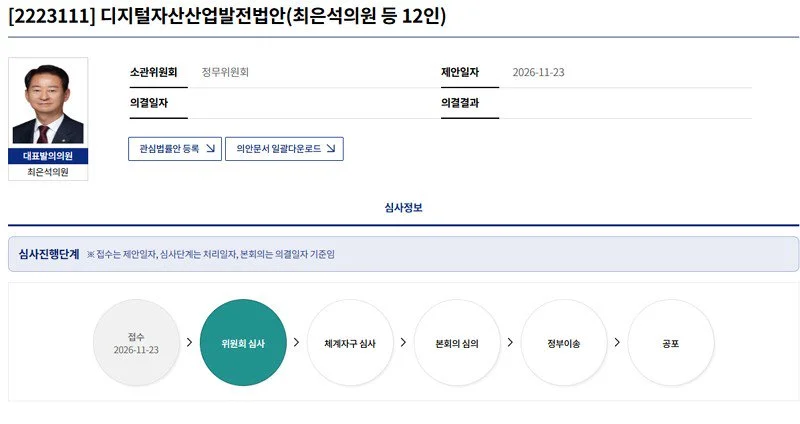
On the 23rd, Rep. Choi Eun-seok of the People Power Party (Strategy and Finance Committee, Daegu Dong-gu Gunwi-gun Gap) introduced the Digital Asset Industry Development Bill as the lead sponsor to clarify the legal rights of digital assets and foster a healthy market ecosystem.
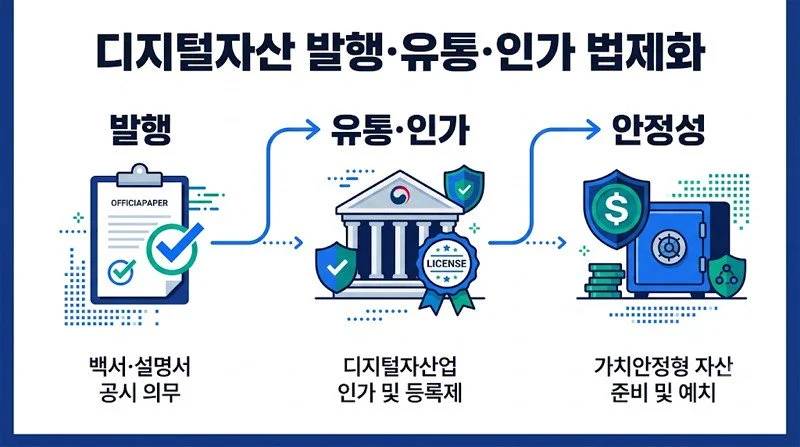
The bill aims to transition all instances of the term "virtual assets" found in other laws to "digital assets." It also includes measures to incorporate the industry into the formal institutional framework by requiring the official disclosure of white papers, mandating cash redemption for stablecoins within three days, and introducing a licensing system for nine specialized business sectors.
Existing laws, such as the Act on Reporting and Use of Certain Financial Transaction Information and the Act on the Protection of Virtual Asset Users, define these entities as virtual assets and focus primarily on money laundering monitoring and post-event punishment, which has limited the industry's development and the prevention of damage in advance.
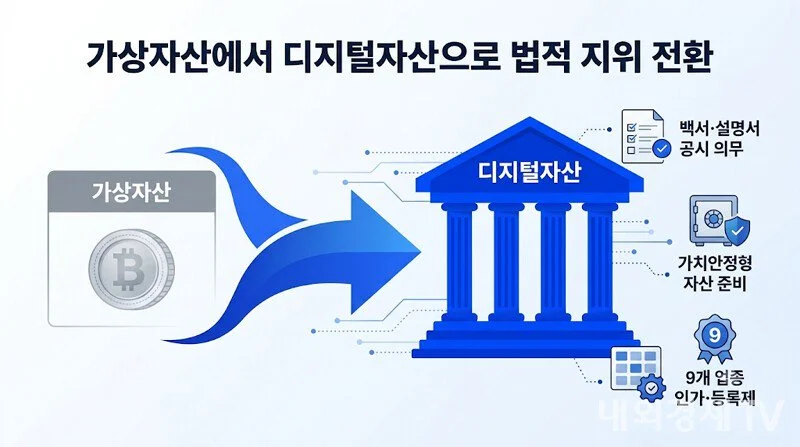
The proposed Digital Asset Industry Development Bill elevates the legal status of these entities by stipulating that upon the law's implementation, all expressions of "virtual assets" and "virtual asset service providers" used in other statutes shall be deemed "digital assets" and "digital asset service providers," respectively.
Technically, the bill broadly covers electronic tokens and rights traded using technologies similar to existing distributed ledgers (blockchain). However, to prevent confusion, it explicitly excludes game items, prepaid charges, electronic stocks, Bank of Korea digital currency (CBDC), and electronic deposits or savings held by banks.
The bill goes beyond a mere name change; it guarantees full property rights by legally recognizing the valid transfer, collateralization, and trust rights of customer assets recorded in a service provider's digital asset ledger. This ensures that even if an exchange goes bankrupt, customer assets will not be subject to seizure or tied up in a bankruptcy estate.
The government will also move away from a purely regulatory approach, as it will be mandated to establish a basic plan for digital asset industry development every three years. Furthermore, companies headquartered overseas will be subject to the law if they affect domestic investors.

Businesses intending to issue new digital assets or sell overseas assets within Korea must upload a white paper—detailing the business plan, total issuance amount, and risk factors—and a sales prospectus to an official integrated disclosure system, similar to a stock investment prospectus. If no white paper exists or it fails to meet standards, a digital asset prospectus must be used.
These documents will take effect on the earlier of the date of posting or 30 days after submission to the association. Existing coins already in circulation must also disclose a prospectus within six months of the law's implementation.
If investors suffer losses due to false or concealed information, the responsible parties will be liable for compensation and may face fines of up to 2 billion won. Stablecoins, which are pegged to the value of the Korean won or the US dollar, will be officially termed "value-stabilized digital assets" and may only be issued by entities with at least 5 billion won in capital that have received authorization from the Financial Services Commission.
Issuers must maintain 100% or more of the total issuance amount in safe assets, such as cash, demand deposits, or government bonds with a maturity of less than one year, and must keep these separately at banks or similar institutions. Upon a user's request for cash exchange, issuers must provide redemption within three days and must undergo monthly disclosure of reserve assets and quarterly external audits.
To prevent being mistaken for deposits, the payment of interest on holdings is prohibited. In cases of concern regarding the stability of the payment system, the Bank of Korea may request a joint inspection or issue an opinion to suspend issuance. For overseas-issued stablecoins, domestic listing or payment handling will only be permitted if it is confirmed that they have the authorization of local supervisory authorities and a protection system for domestic investor redemption.
The industry, which was previously grouped under a single reporting system for virtual asset service providers, will be divided into nine specialized digital asset business sectors based on the nature of their work.
The trading, exchange, and brokerage (exchange) sector must have at least 1 billion won in capital and receive authorization from the Financial Services Commission. The remaining seven fields—custody and management, payment and transfer (payment/remittance), discretionary investment, collective management (funds), lending, advisory, and trading/exchange agency—must be formally registered with at least 500 million won in capital.
Entities that do not receive formal authorization or registration are prohibited from using "digital asset business" or "virtual asset business" in their trade names. In the event of a company's closure or bankruptcy, the Digital Asset Protection Foundation will take over and safely return customer assets.
Additionally, the bill codifies the listing and delisting (trading support) review process for exchanges, requiring an independent body to make the decisions. It also prohibits proprietary trading by exchanges within their own markets and excessive coin lending that exceeds the exchange's ability to repay users.
For the use of undisclosed information, market manipulation, and fraudulent transactions, fines of up to twice the amount of unjust enrichment (or up to 4 billion won if calculation is difficult) will be imposed. The bill also establishes penalties for market disturbance through repeated false orders (a fine of 500 million won or up to 1.5 times the unjust enrichment) and introduces powers for the immediate suspension of payments to suspicious accounts and the authority to conduct search and seizure.
The establishment of the Korea Digital Asset Industry Association as an official self-regulatory body and the right to apply for mediation through the Financial Dispute Mediation Committee are also guaranteed. The law is expected to take effect one year after its promulgation (six months after for authorization and registration provisions), and existing service providers must re-apply for authorization or registration under the new standards within six months of implementation.
A total of 12 members participated as co-sponsors of this bill, including Rep. Choi Eun-seok, Ko Dong-jin, Kim Sang-hoon, Sung Il-jong, Kim Eun-hye, Seo Myeong-ok, Kim Tae-gyu, Kwon Young-jin, Kim Jae-seop, Ahn Cheol-soo, Song Eon-seok, and Lee Jong-bae.
Comments 0